
Short answer
Rhodium plates over nickel. Degrease at 10 to 12V DC, plate nickel at 5 to 6V (with a copper flash first on steel or brass), then stroke the rhodium pen over the nickel at 8 to 10V. It deposits about 0.7 µm in 2 minutes on a 1 in² area, the fastest of the standard pens, up to 1.5 to 1.8 µm. The pen is $310.
This job is done with brush plating, a form of selective plating that puts metal only where the pen tip touches.
Where a rhodium pen is used
- Premium electrical contacts
- Optical components and instrument work that need a hard, highly reflective surface
- Wear surfaces where a small area needs the hardest finish available
Rhodium needs nickel under it
| Base metal | Sequence |
|---|---|
| Nickel | Degrease, then rhodium |
| Copper | Degrease, nickel, then rhodium |
| Brass, steel or zinc die-cast | Degrease, copper flash, nickel, then rhodium |
| Gold or silver | Degrease, copper flash, nickel, then rhodium |
| Stainless steel | Stainless degreaser, copper flash, nickel, then rhodium |
| Aluminum | Not supported by the Micro-Metallizer system |
Step by step
- 01
Remove oxide and discoloration
If the surface is discolored or oxidized, polish it with a fine metal polish until the oxide is gone, then wipe it clean with a lint-free cloth.
- 02
Degrease at 10 to 12V
Set the supply to 10 to 12V and use the Absorbent / Degreaser pen (PL-1002). Connect the part to the negative (−) lead of the power supply and the pen to the positive (+) lead. Hold the pen so the whole tip touches the surface, and move it lightly back and forth in a slow stroke. Small bubbles form as oil and grease come off. Wipe the area clean with a cloth when done. Stainless steel takes the Stainless Steel Degreaser pen (PL-1014) instead.
- 03
Build the nickel base
On anything that is not copper or nickel, flash copper with the Copper pen (PL-1010) at 6 to 8V. Then plate nickel with the Nickel pen (PL-1006) at 5 to 6V. Wipe clean with a cloth between pens. Skip this step if the surface is already nickel.
- 04
Plate rhodium at 8 to 10V
Set the supply to 8 to 10V and switch to the Rhodium pen (PL-1011). Connect the part to the negative (−) lead of the power supply and the pen to the positive (+) lead. Hold the pen so the whole tip touches the surface, and move it lightly back and forth in a slow stroke.
- 05
Build to thickness
The rhodium pen deposits about 0.7 µm in 2 minutes and 1.0 µm in 3 minutes on a 1 in² area, up to 1.5 to 1.8 µm.
- 06
Wipe clean
Wipe the part with a clean, soft cloth.
Order the parts for this job
In stock. Ships same day on orders placed by 2 PM ET on business days.
- Rhodium Plating PenPL-1011$310.00
- Deluxe Kit (Heavy Duty)PL-1000HD$900.00
- Nickel Plating PenPL-1006$70.00
- Contact Repair KitPL-1000C$400.00
Making an expensive pen go further
Each pen holds 10 ml of concentrated solution and covers roughly 300 square inches, which works out to about $1.03 of rhodium solution per square inch at the $310 list price. Because rhodium only deposits where the tip touches, none of it goes onto surfaces that do not need it.
If the job needs a tarnish-resistant white finish but not the brightness of rhodium, the Palladium pen is $140 and plates over the same nickel base.
What you need
The Rhodium pen ($310), Nickel pen ($70), Absorbent / Degreaser pen ($65), power supply ($220) and connector cables ($20) come to $685. Add the Copper pen ($65) for steel or brass.
The Deluxe Kit, Heavy Duty ($900) is the one kit that includes a rhodium pen, along with heavy-duty nickel, copper, silver and 24K gold pens, the degreaser, power supply and cables. Bought separately those parts come to $1,190.
Frequently asked questions
Can you rhodium plate with a pen?
Yes. The Rhodium pen (PL-1011) brush plates rhodium over nickel at 8 to 10V DC, with no tank.
Does rhodium need a nickel underlayer?
Yes. Rhodium plates over nickel. Surfaces that are not nickel get a copper flash, then nickel, then rhodium. Copper needs only the nickel.
What voltage does a rhodium plating pen use?
8 to 10V DC, with the part on the negative lead and the pen on the positive lead.
How thick is brush-plated rhodium?
About 0.7 µm in 2 minutes and 1.0 µm in 3 minutes on a 1 in² area, up to 1.5 to 1.8 µm.
Why does the rhodium pen cost more than the others?
Rhodium is the most expensive of the plating metals in the line. Precious metal pen prices can change with metal markets.
Shop the parts in this guide
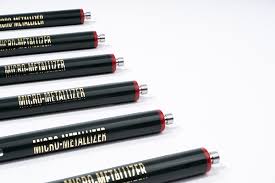
Rhodium Plating Pen
Premium rhodium plating for the hardest, most reflective finish available. Plates over nickel; apply copper flash and nickel first on non-copper surfaces.
Deluxe Kit (Heavy Duty)
Premium heavy-duty complete kit. Silver-Heavy, Copper-Heavy, Gold 24K-Heavy, Nickel-Heavy, Rhodium, and Absorbent pens included.
110V / 220V · choose in cart
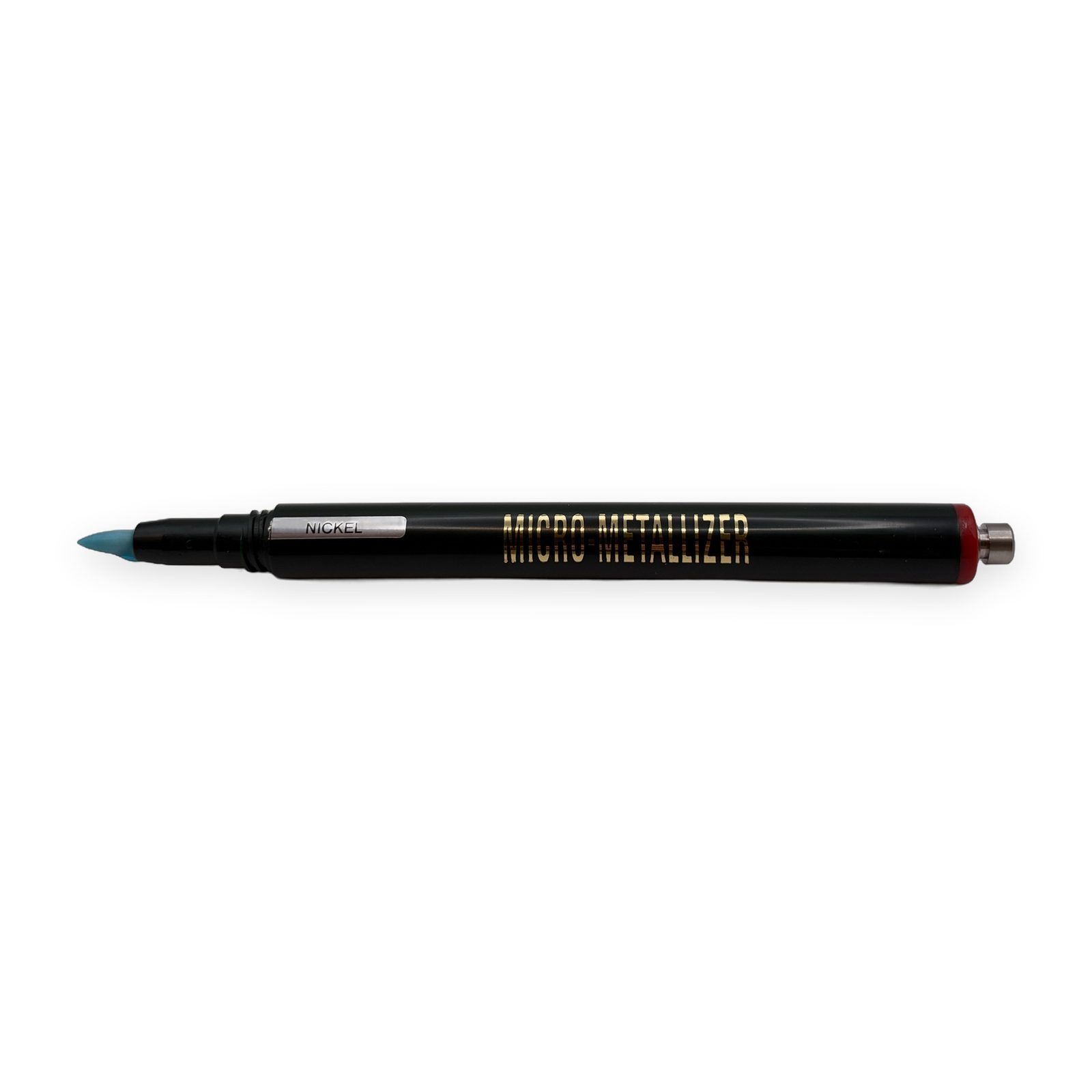
Nickel Plating Pen
Plate nickel over copper surfaces. Apply copper flash first on non-copper substrates. Essential underlayer for many plating sequences.
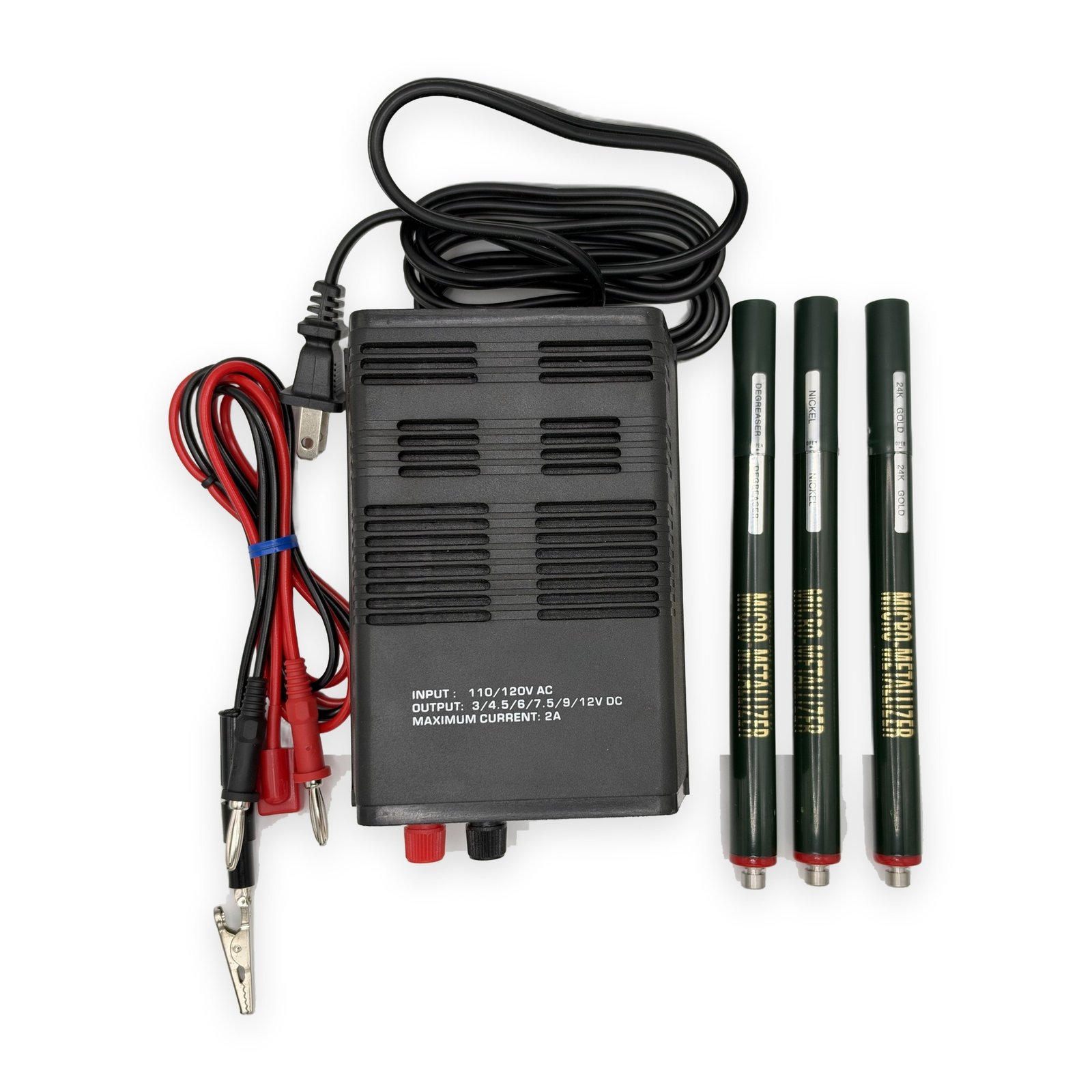
Contact Repair Kit
Complete repair kit for electronic component restoration. Includes power supply, connector cables, Absorbent, Nickel, and 24K Gold pen.
110V / 220V · choose in cart
Not sure which pens your part needs?
Tell us the substrate and the finish you need. Our team will tell you the sequence.